
Drill, baby, Drill!
A phrase well spoken. Catchy, cheeky… populist. After all, the comforts of modern life depend on fossil fuels. For most people in America — and most places in the world — fossil fuels are the essential arteries that pump the blood of our every day. Not only do they heat our homes and power our vehicles, but they are woven into the clothes we wear, the food we eat, the water we drink, and the air we breathe.
Environmental concerns aside, it makes economic sense to bolster fossil fuel extraction in the United States and relax environmental regulations. Some animals might lose their home, but that’s the cost of keeping the lights on, right?
Right?
On Feb. 28, 2026, Israel and the United States launched airstrikes on multiple cities in Iran resulting in the death of Iranian officials, including supreme leader Ayatollah Ali Khamenei. These attacks have triggered a cascade of retaliatory strikes from Iran: attacks on U.S military facilities within the region, as well as on civilian and energy infrastructure near the Persian Gulf. Iran has also effectively closed the Strait of Hormuz, a one-hundred-mile-long and twenty-one-mile-wide strait that guides the flow of over 20% of global oil production.
In 2024, the passage averaged 20 million barrels of oil per day — oil that is primarily consumed by Asian countries including the Philippines, India, and Japan. That’s exactly why these nations are experiencing the brunt of the conflict, especially the closure of the Strait of Hormuz. The Philippines have declared a national energy emergency, while Sri Lanka and Pakistan have enacted four-day work weeks to conserve energy during the ongoing oil crisis. The rate of global crude oil has been volatile, varying up to $35 dollars in a single day and costing up to $110 dollars per barrel of crude. Prior to the attacks, crude oil was pushing around $70 per barrel.
This is where the bumper sticker slogan comes in. Since taking office in 2025, President Trump has made a commitment to increasing domestic fossil fuel production. There have been massive movements of U.S. crude oil extraction under his leadership, with 13.6 million barrels per day being produced in 2025 — a 200,000-barrel increase from the year before. Just this month (the same month as the oil crisis), Trump approved a $5 billion oil drilling project 250 miles off the coast of Louisiana. Trump’s pursuit of oil has also dismantled many environmental frameworks that discourage oil extraction.
These environmental rollbacks are vast and plentiful: modifying the EPA website to remove any language indicating human-related climate change impacts, attempting to weaken the Endangered Species Act (efforts which were shot down by federal judges as of Tuesday, March 31, 2026), and withdrawing the United States from international climate organizations such as the UNFCCC, and the IPCC.
But aren’t these steep price tags of environmental degradation worth the energy independence that domestic fossil fuel production gives us?
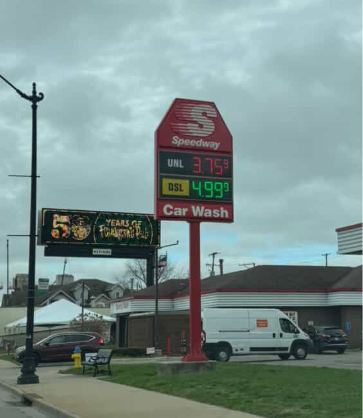
So why have gas prices risen approximately $1 per gallon in the past month?
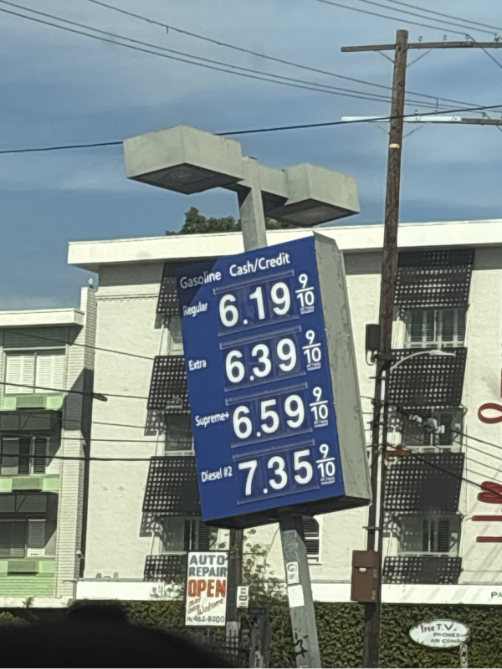
During my spring break in Los Angeles, I couldn’t help but stare at the $6.19 illuminated on the pump display. For regular, mind you.
Why are Americans feeling these pressures from the closure of the strait even after we’ve opened up vast stretches of public and private land for extraction?
What Determines the Price of Oil?
I’m not an oil analyst. All I know is that when I pulled my Mazda into a gas station last week, I felt my chest tighten as I reached for my wallet. That helpless feeling at the chip reader is what sent me down the rabbit hole:
What actually dictates the price of oil, and how can any one person — or nation — meaningfully influence it?
The price of oil boils down to supply, demand, and geopolitics.
Oil follows the classic relationship between supply and demand. When the product is abundant, prices fall; when it is scarce, prices rise.
The Organization of Petroleum Exporting Countries (OPEC) is a coalition of twelve oil-producing nations that collectively control roughly 40% of global oil output — making it the single most powerful force in setting oil prices historically. The United States, the world’s largest oil producer since 2018, is the only other player with comparable influence.
So more American oil means more global supply, which should push prices down.
Theoretically.
The third factor, geopolitics, is where supply and demand stop being textbook concepts.
War, sanctions, a closed strait: these impacts are almost instantaneous. There’s no gradual adjustment period. Instead, the market grapples with these situations in real time, and often chaotically.
American refineries don’t buy American oil at some insulated domestic rate. When supply tightens anywhere, prices rise everywhere.
Now this is an extremely simplified version, all to get to the point that true energy independence isn’t achieved through fossil fuels alone.
A field of monocultures looks strong until one disease wipes it out.
An energy grid built on a single source displays the same fragility.
Diversity = Securities
In nature’s ecosystems, diversity is a foundational strength.
It provides resilience and buffers against the damage that drought, disease, or disruption can cause. In commercialized agriculture, we routinely grow acres of one single crop —whether it’s corn, wheat, or barley.
It’s “efficient,” until it isn’t.
One pest, one disease, or one unusually cold freeze can erase an entire season’s harvest and implicate disastrous effects for local and global communities.
An energy grid built on one source is just another monoculture susceptible to its own different kinds of diseases, pests, and disturbances.
Honeywell — a global conglomerate serving the aerospace, defense, and energy sectors — argued in 2025 that economies relying on a mix of wind, solar, hydrogen, and natural gas are better insulated from price volatility and grid disruptions than those dependent on any single source.
This isn’t just a message from the Sierra Club anymore. The argument for investments in renewable energy no longer needs to be centered on environmentalism.
“Solar photovoltaic (PV) was 41% cheaper on average than the lowest-cost fossil fuel alternatives, such as gas, while onshore wind projects were 53% cheaper,” a 2025 report by the International Renewable Energy Act (IRENA) concluded.”
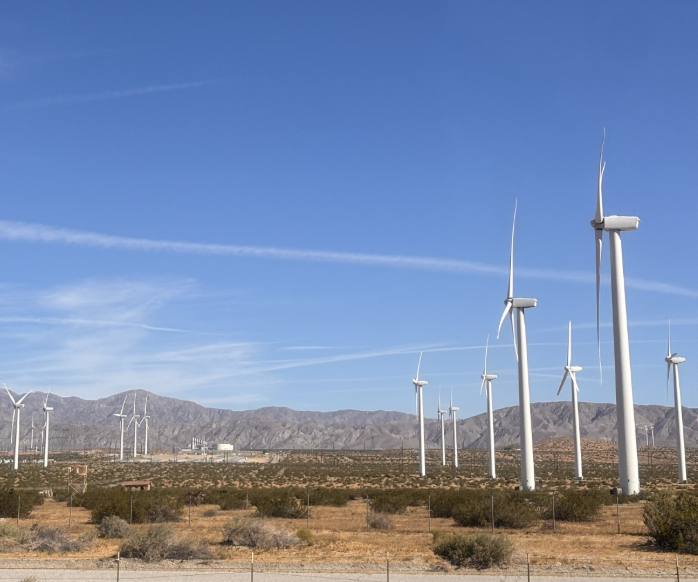
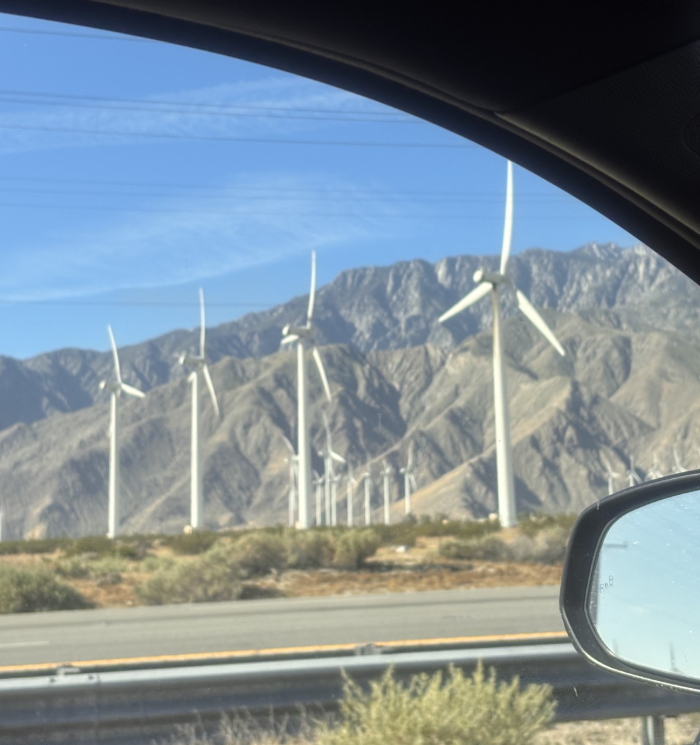
When the Strait of Hormuz closes, American solar panels can keep working. When a pipeline ruptures, American wind turbines can keep spinning. Renewables aren’t just a talking point for democratic candidates. They’re a necessity for all Americans — wherever they lie on the political spectrum.
So, the question worth asking isn’t whether America should produce more oil.
I think the question worth investigating is why the current administration is actively dismantling the investments and regulatory frameworks that would make independence actually achievable.
The White House website claims:
“President Donald J. Trump has delivered on his promise to unleash American energy, putting an end to years of burdensome regulations, job-killing mandates, and foreign-dependent policies.”
However, within the same breath, the Trump administration has also paid French energy giant TotalEnergies $1 billion to discard a plan to build wind farms off the East Coast and instead invest that money into oil and gas projects.
These inconsistencies are hard to explain through policy logic. When the decisions that shape national energy infrastructure happen to align with private financial interests — or private aesthetic ones (wind turbines on someone’s golf course) — it’s worth asking who exactly this infrastructure is being built for.
It’s not being built for the generation of future Americans who are going to pay the price of fossil fuel dependence through the smog pollution that lines their lungs.
And it’s proving not to be built for the person today standing at the pump, staring at a number they can’t afford.
The opinions on this page do not necessarily reflect those of The Sandspur or Rollins College. Have any additional tips or opinions? Send us your response. We want to hear your voice.





Comments are closed.