
Historic Decline
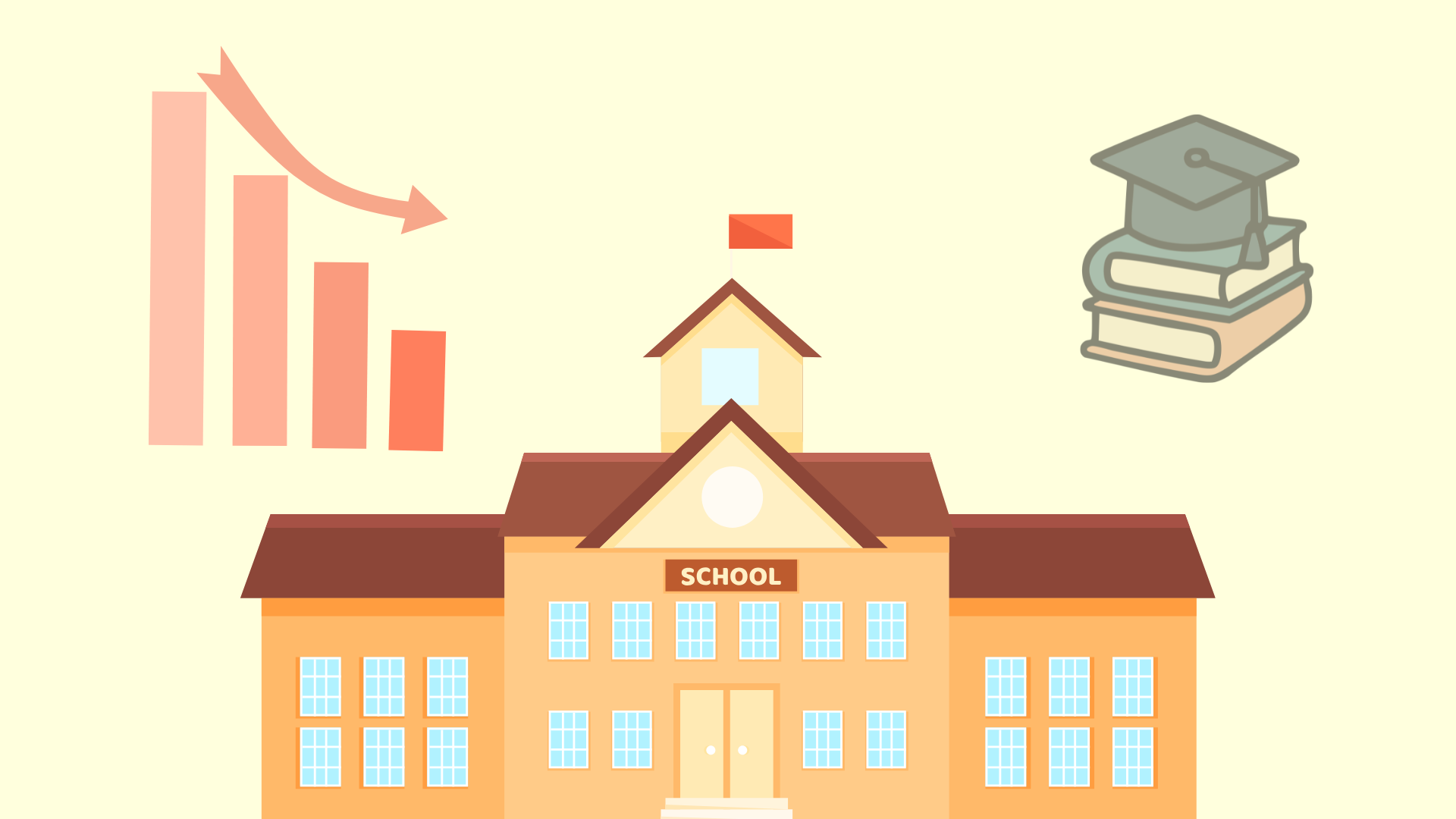
The U.S. public school system experienced a historic 3 percent enrollment drop in 2020 — the largest single-year decline since 1943, when many teenagers dropped out of high school due to World War II. At the time, the loss of enrollment was widely attributed to the COVID-19 pandemic. Four years later, the pandemic is seen as a catalyst rather than a cause.
Currently, the National Center for Education Statistics projects an additional 5 percent decline in public school enrollment by 2031 for K-12 schools. This decline appears to be primarily driven by falling birth rates that have not recovered since the Great Recession of 2007-2008 — a trend confirmed by the Centers for Disease Control and Prevention. In addition, enrollment in private schools and homeschooling has risen steadily since 2020, though it is difficult to quantify the extent of that shift.
The scale of the post-pandemic exodus is beginning to come into focus. Between the 2019-2020 and 2021-2022 school years, roughly 2.05 million students went “missing” from both public and private enrollment records — a 450 percent jump compared to the prior year. These students may have dropped out of formal education entirely, raising concern about the most vulnerable populations — children from low-income families, unstable housing situations, or families navigating immigration fears who may be keeping children home with no structured alternative in place.
Projections to 2050 offer a range of outcomes. Even if families return to pre-pandemic enrollment habits, overall population decline alone is expected to reduce public school rolls by about 2.2 million students. If families continue to choose alternatives such as private school, homeschooling, or no school at all, traditional public schools could lose as many as 8.5 million students.
Florida Schools’ Reality
Volusia, Brevard, Flagler, Lake, Marion, and Polk counties all reported lower enrollment the prior year.
District officials cite Florida’s universal voucher program, which provides state-funded scholarships for eligible students to attend private or home schools, as a primary cause.
Orange County has experienced the steepest loss of any district in Central Florida, with roughly 7,000 fewer students enrolled this fall — about double what officials had projected. The district anticipated a $28 million budget shortfall tied to enrollment decline, but officials now warn the total loss could grow by another $25 million. The district has imposed a hiring freeze on instructional positions and may reassign teachers. School leaders have taken their case to Capitol Hill, pressing for additional federal funding as the voucher program continues to redirect dollars away from public classrooms.
A portion of the absent students come from immigrant families. Orange County officials and advocates, including the Farmworkers Association of Florida, say fears of Immigration and Customs Enforcement activity near school campuses have led some parents to keep children at home or seek other options.
Who Gets Left Behind
The students most likely to remain in traditional public schools as others leave are often those with fewer alternatives, including students from low-income families, students with disabilities, and those who depend most heavily on the services public schools are equipped to provide. This connects back to the “missing students” issue. Their disappearance from records does not mean they have found better options; in many cases, it means they have fallen out of formal education entirely. Less students means fewer graduates, which imposes a “looming crisis for the economy”, as it would lead to a lack of professionals filling up jobs that require higher education.
Educational experts warn that continued enrollment decline will affect the most vulnerable students, leading to layoffs, larger class sizes, reduced special education and gifted resources, and, in some cases, school closures.
The Risk of the Wrong Reaction
The traditional institutional response to declining enrollment is consolidation — merging schools into larger structures to reduce costs. Educators and researchers warn this approach is likely to worsen the enrollment decline.
Evidence shows that smaller school communities outperform larger institutions in student engagement, attendance, sense of belonging, achievement, graduation rates, and postsecondary success. Those benefits are most pronounced for historically underserved students, who are otherwise most likely to end up in large, impersonal, under-resourced settings.
If districts pursue school mergers, they risk accelerating the exodus they are trying to slow. Families are likely to continue seeking other options for their children based on benefits, deepening funding losses and making conditions more difficult for the students who remain in public schools.
What Comes Next
The enrollment crisis is not uniform, and its causes vary by geography. Falling birth rates are a national constant; the voucher program issue is most acute in states with expansive school choice legislation; immigration-related absences are concentrated in communities with large immigrant populations. The cumulative effect — fewer students and less funding — is a reality in many districts across the country.
The decisions made now — about school size, resource allocation, and how to serve the students who remain in public settings — will shape American public education for future generations. With the full weight of a demographic decline still years away, public school systems have a window of time to adapt.







Comments are closed.