
When Don Davison came to Rollins College in 1989, it wasn’t a long-term plan. In fact, Davison wasn’t positive he would remain in academia at all.
“I had been offered a position elsewhere, and I really wasn’t looking to make a big move,” Davison said, “but the faculty here kept encouraging me to apply. It all felt very serendipitous at the time.”
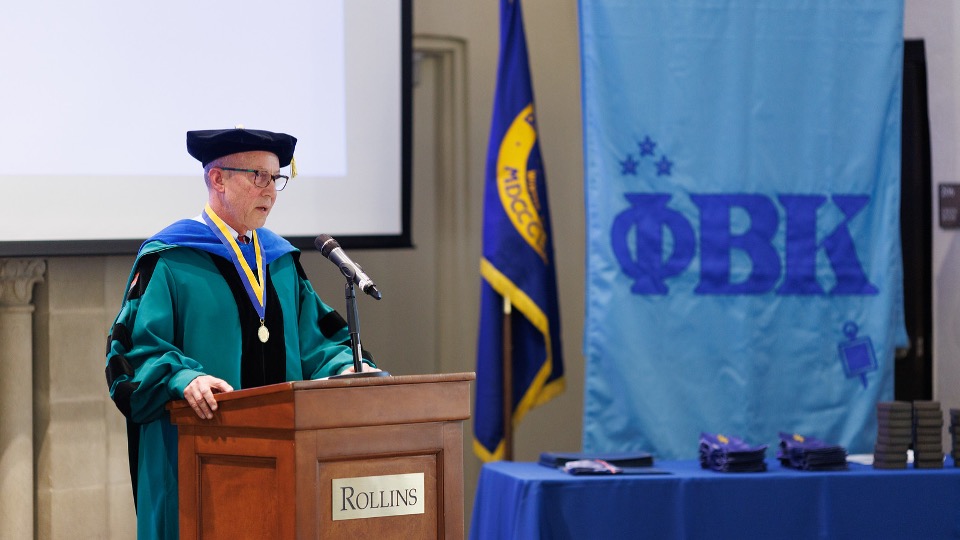
That one decision led to a 37-year career that influenced almost every corner of Rollins — from faculty governance seminars to growing the concept of Rollins alone. As Davison looks back at nearly four decades as a professor, figurehead, and provost, he sees the transformation of Rollins College — a transformation that he had a direct role in.
A Transforming Campus
When Davison first arrived at Rollins College, it felt a lot smaller than it does today.
“In 1989, we had about 1,600 students. Today it’s closer to 2,300 students,” he said. “The faculty grew from around 120 to nearly 200. The physical campus changed dramatically.”
More buildings were constructed, and enlarged infrastructure upgraded student life but also came with compromises. “We lost a considerable amount of green space as construction increased,” he said. “But those changes also brought new opportunities: new programs, new spaces, and a campus that could support a growing student body.”
One of the most positive shifts on campus that Davison has observed is in the students.
“Our student body is far more diverse — racially, economically, and in terms of backgrounds — than it was when I started,” he said. “That diversity enriches the liberal arts experience in ways that are hard to overstate.”
Experimentation that Formed the Lecture Hall
Davison’s scholastic research — focused on ethnicity, voting rights, and democratic representation — formed most of his instructional teaching.
“My work on voting rights and democratic erosion helped drive the questions I brought into the classroom,” he said. “Questions about fair representation, inclusion, and the ethical foundations of democratic government became core to my upper-level courses.”
There was enjoyment for Davison in helping students understand difficult ideas, especially at times where everything seemed to finally make sense. One victory that stuck with Davison was a moment when a student accurately worked through a multivariate regression equation in class.
“It was one of those moments where you see the student realize, ‘I can do this,’” Davison said. “My job was to reassure them that yes, they could, and to celebrate when they did.”
The classroom was also a place where Davison experienced personal achievements.
Another unforgettable moment within the classroom is the time his wife, also professor, went into labor during a lecture. “That’s not something you forget,” he said.
Serendipity in Administration
Davison never planned to transition from teaching to administration, but just like when he first came to Rollins, the path laid itself out for him.
“I was happy teaching and doing research. Administration wasn’t something I was pursuing,” he said. “It was always someone else saying, ‘You should do this,’ and I eventually stepped into those roles.”
Davison’s reasons for staying were always distinguished at Rollins: he valued the power of faculty jurisdiction.
“Shared governance mattered deeply to me,” he said. “I wanted to be sure faculty had a strong voice in the direction of the institution.”
Benefaction that Stands
In addition to his commitment to democratic leadership at the institutional level, Davison has played a role in several structural improvements to Rollins. He highlights his work in equitable faculty compensation as one such example.
“It was important to ensure faculty were compensated fairly and that we eliminated disparities,” he said. “Those were big, complicated efforts, but essential ones.”
Davison also played important roles in structuring and fixing the curriculum, aiding in establishing programs such as the Public Policy and Political Economy major and the Data Analytics minor.
“Giving new faculty early space to launch their teaching and scholarship agendas was critical,” he said. “Those initiatives have helped professionalize and support the faculty in meaningful ways.”
Serendipity at Rollins
Davison sees his contributions to Rollins as a time to work with others, collectively reaching milestones and getting ready for the next best thing.
“I stayed because I enjoyed working with our students and because Rollins gave me the chance to grow,” he said. “I’ve been lucky. A lot of it was serendipity. But it’s been a wonderful place to spend a career.”








Comments are closed.