
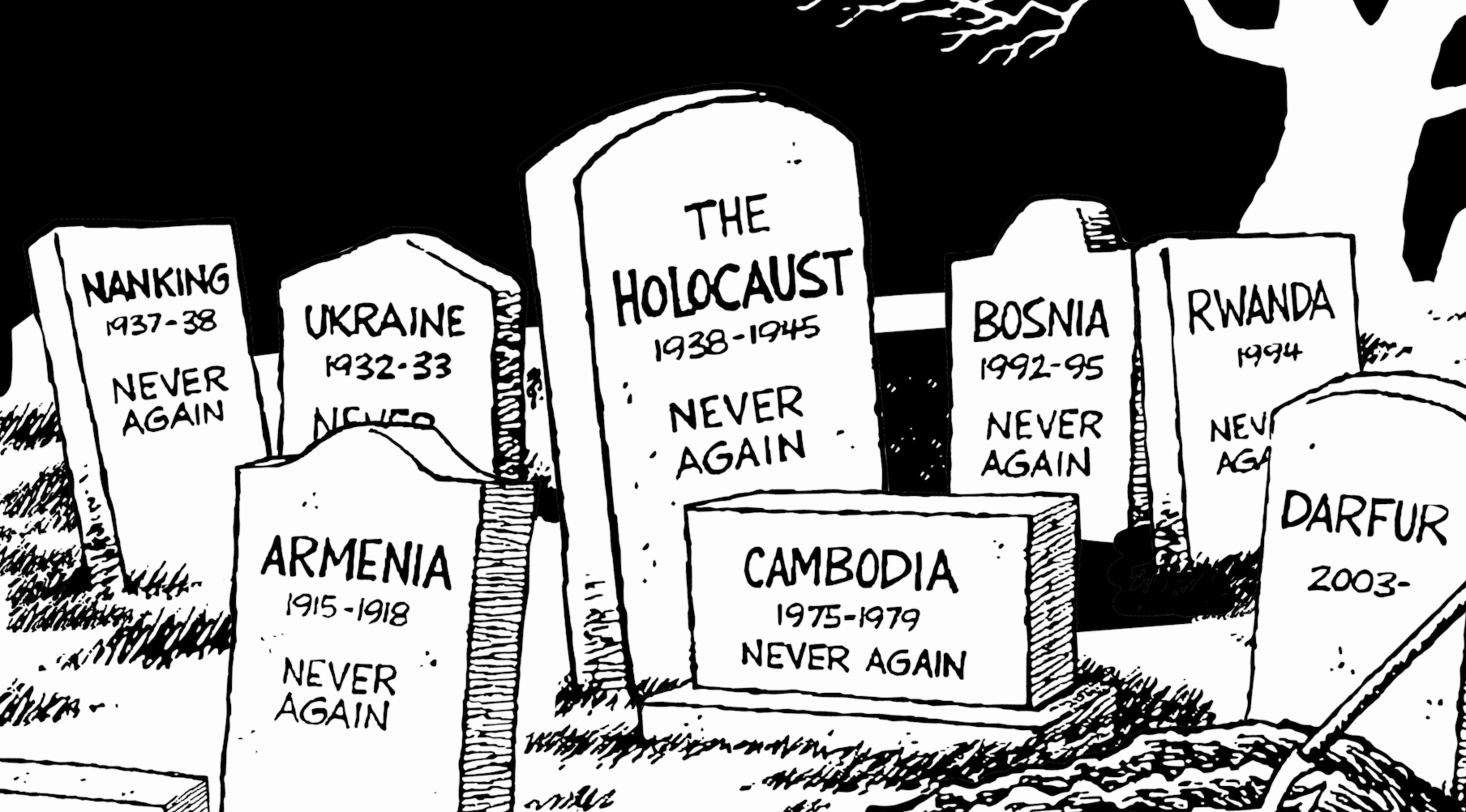
“Evil, I think, is the absence of empathy.”— Captain Gustave Mark Gilbert, U.S. Army psychologist at the Nuremberg Trials, quoted in “For the Living.”
The cyclists begin their journey on a cloudy day. Though smoothly paved roads and scenes of the countryside await them, behind them they leave an abandoned gatehouse and set of train tracks. This is the start of the Ride For The Living (RFTL), an annual 60-mile bike ride that mirrors the liberation path that Holocaust survivor Marcel Zielinski walked in 1945 from the Auschwitz-Birkenau concentration camp to Kraków, Poland.
“For the Living” allows audiences to hear Zielinski’s story through his own words and explores his friendship with Robert Desmond, a software developer and cyclist who helped inspire the creation of RFTL. On the dynamic between the two, producer Lisa Effress said, “I could see the love, compassion, and care they had for each other. That’s when it became obvious that we needed to focus on their relationship.” Co-director Tim Roper described Desmond and Zielinski’s relationship as a “masterclass in empathy,” recounting that Desmond, speaking about Zielinski’s experiences, said, “that could have been me.”
Alongside accounts of the Holocaust, the film references the displacement of Indigenous peoples in the U.S., the enslavement of Africans, the Armenian genocide, the Tutsi genocide in Rwanda, the Darfur genocide in Sudan, the Cambodian genocide, and the Bosnian genocide. On his experience researching these histories, Roper said, “Curating over 900 photographs and clips for the film was a dark experience. You have to get very clinical and technical with it and not let it drag you down. I still get emotional almost every time I watch the film, and I’ve watched it hundreds of times.”
Rather than “singlehandedly solving any problem,” Roper hopes that “For the Living” can help spark conversation and encourage people to think introspectively. “We’re all capable of the evil things that you see in this film. Even the best of us can start to take on prejudices and dehumanizing thoughts and attitudes,” he said. “People get caught up in psychology and pressure and demagoguery and propaganda and they become bystanders at the very least, or perpetrators.”
Roper expressed concern about younger generations’ apathy toward learning history. “I don’t expect everybody to be a historical expert, but you can’t understand the way the world is now unless you know how we got here,” he said. Beyond improving historical education, Effress and Roper stressed the importance of teaching empathy.
“I would encourage parents to teach their kids at a very young age to recognize others as the same, not as less than or other than,” said Effress. “I think people are good. I think they learn evil.”
“Personalizing history and teaching historical events through the experiences of individuals is the way to get students to say ‘that could have been me,’” said Roper. “That child in the Holocaust, or that young woman in slavery, or the family in Cambodia, that could have been me. What if I went through that? If you think about it that way, history becomes much more engaging and interesting.”
“For the Living” was screened at the 2025 Global Peace Film Festival on Thursday, Sept. 18, at the Winter Park Library. For more information on “For the Living,” you can visit forthelivingmovie.com.













Comments are closed.