
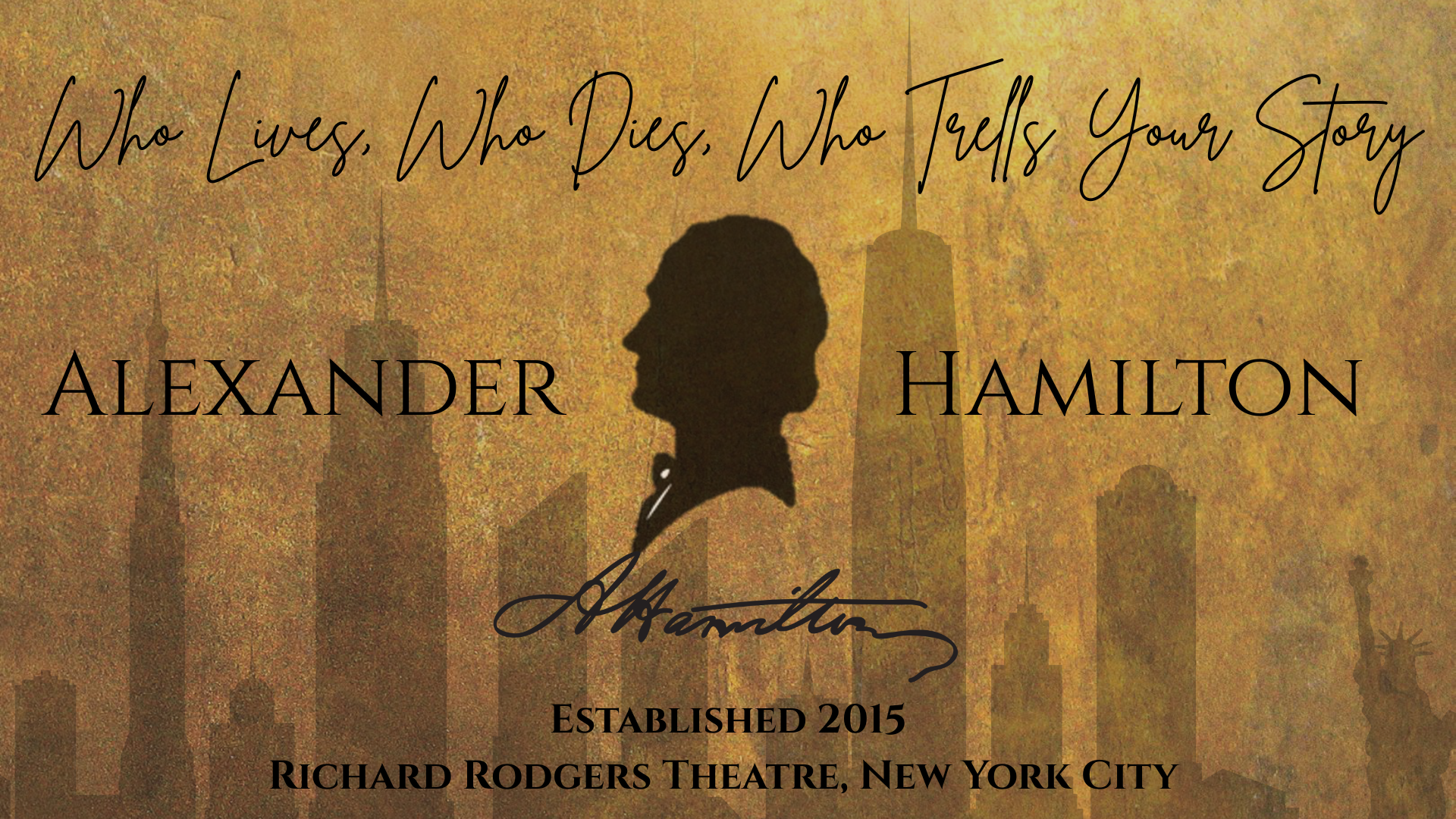
Crowds pack the sidewalk of West Forty-Sixth Street, just a few steps away from Times Square. It’s not an unfamiliar sight; there are three theatres within that block, all currently occupied, but on this day there’s an unfamiliar buzz in the air. Two months ago, the original Broadway cast of “Hamilton” reunited at the Tony Awards for the first time to a standing ovation. Today, the crowds lining West Forty-Sixth Street are there for the same reason: to watch as the show that helped to change Broadway turns ten.
On Wednesday, August 6, “Hamilton” turned ten. The rap/hip-hop musical written and composed by Lin-Manuel Miranda and directed by Thomas Kail (“In The Heights,” “Sweeney Todd”) was met with laughter the first time it debuted; yet ten years later the Tony Award-winning show has played over three thousand shows, and spawned six productions, including a West End run and four US tours.
A musical based on history isn’t a first for Broadway. Shows like “Les Misérables” (Schönberg & Boublil), “Chicago” (Kander & Ebb), “Cabaret” (Kander & Ebb), and “The Sound of Music” (Rodgers & Hammerstein) all precede the revolution in using the stage as a creative medium to tell the story of history.
What sets “Hamilton” apart from other historical shows, though, is the decision to write a musical about a mainly unknown Founding Father whose only claim to fame was his feature on the ten-dollar bill and the creative choice to use rap and hip-hop to tell his story.
“Hamilton,” as the name suggests, tells the story of Founding Father and Treasury Secretary Alexander Hamilton. Born in 1757, Hamilton moved to New York City from the West Indies and attended Kings College (now Columbia University) at the height of the independence movement. While serving as George Washington’s aide-de-camp during the Revolution, he married Elizabeth Schuyler, whose relationship is a prominent feature of the musical and with whom he had eight children. Following the conclusion of the Revolution, Hamilton was named as a delegate to the Constitutional Convention and, with the creation of the executive branch, was appointed by now President Washington to be Secretary of Treasury. As a member of the Federalist Party, Hamilton found antagonists in Senator Aaron Burr and Secretary of State Thomas Jefferson — both members of the Democratic-Republican Party — the former of which resulted in Hamilton’s death in 1804.
“Hamilton” was born in 2008 when, following his Broadway debut in “In the Heights,” Lin-Manuel Miranda picked up a copy of Ron Chernow’s “Alexander Hamilton” at an airport bookstore to read on vacation. After spending close to seven years to bring “In the Heights” to Broadway, Miranda said, “the moment my brain got a moment’s rest, ‘Hamilton’ walked into it.” Chernow’s “Alexander Hamilton” is nowhere close to a short book, clocking in at 818 pages, but through his writing, Miranda began to imagine the possibility for an “Alexander Hamilton” musical.
A year later, Miranda was invited to perform a song from “In the Heights” at the White House Evening of Poetry, Music, and Spoken Word. Instead, he chose to debut the opening number for a show he called “The Hamilton Mixtape.” When introducing “The Hamilton Mixtape,” Miranda said that he was “working on a concept album about the life of someone I think embodies hip-hop, Treasury Secretary Alexander Hamilton.” Upon this introduction and throughout his performance, Miranda was met with laughter by his audience. That White House performance video now has over ten million views on YouTube.
Debuting off-Broadway in February 2015 at the Public Theater, “Hamilton” had a sold-out limited run that was extended twice through the beginning of May. Opening at the Richard Rodgers Theatre (where Miranda had previously played “In the Heights”) on August 6, “Hamilton” won both a Grammy and Pulitzer in its first six months before taking home eleven Tony Awards at the 2016 Tonys.
Now, ten years later, there’s perhaps not a musical that holds a legacy as powerful as “Hamilton.”
But what makes “Hamilton” so special?
America Then Told by America Now: The Political Legacy of ‘Hamilton’
In a 2015 New York Times article, Miranda described “Hamilton” as “a story about America then, told by America now… our story should look the way our country looks… I think it’s a very powerful statement without having to be a statement.”
In 2016, the Vice President-elect Mike Pence attended a production of “Hamilton” following the 2016 election. At the curtain call — the moment following bows — Brandon Victor Dixon, who was playing Vice President Aaron Burr, gave a speech directed to Pence, “We are the diverse America who are alarmed and anxious that your new administration will not protect us, our planet, our children, our parents, or defend us and uphold our inalienable rights, sir.”
The following day, President-elect Donald Trump tweeted his dissatisfaction with the cast and demanded an apology from them, saying that Pence had been “harassed.” He did not receive that apology.
Now, eight years later, “Hamilton” finds itself once again in the crosshairs of the Trump Administration, when it was announced that they would not be performing at the Kennedy Center in honor of America’s 250 birthday after Trump named himself chairman of the venue. In a statement, producer Jeffrey Sellers said, “Our show simply cannot, in good conscience, participate and be a part of this new culture that is being imposed on the Kennedy Center.” The new president of the Kennedy Center, Richard Grenell, responded by calling Sellers’ choice “a publicity stunt that will backfire.”
“Hamilton” has always been political; a cornerstone of art in the Obama era, it has been praised by politicians from the Obamas to the Cheneys as a bipartisan retelling of early American history. “Conservatives might say,” Miranda said in an interview with Daniel Pollack-Pelzner, “I don’t agree with Lin’s politics, but the way he wrote about Washington was great,” and conversely the left could go, “These guys were all slaveholders, but it’s thrilling to see people of color telling the story.” The roles of King George III — portrayed by Jonathan Groff in the original Broadway production — and loyalist Thomas Seabury are the only white roles in the cast.
While Miranda does take creative liberties with the story of Hamilton and his counterparts, it cannot be forgotten that the story being told is a story of real people, of a nation going through a similar struggle as it was 250 years ago. Creative pieces of American history often describe the Founding Fathers as perfect, people who have done no wrong. Miranda does the opposite — the major climax of Act 2 is Hamilton’s affair with Maria Reynolds and the resulting government scandal — and the show is as much Eliza’s as it is Alexander’s.
With no signs of slowing down, the impact of “Hamilton” continues to be shaped by the ever-changing political landscape, none as evident as with the current administration, though the reach of “Hamilton” stretches much beyond the political throes of Washington, DC. With the movie theater debut of the 2020 Disney+ pro-shot coming in early September, the legacy of “Hamilton” among the next generation continues to grow.
History Has Its Eyes on You: The Educational Legacy of ‘Hamilton’
Less about revolution, “Hamilton” focuses on the idea of legacy and building the new nation. As Miranda and co-star Leslie Odom Jr. sing in the penultimate number of Act 1, “You will come of age with our young nation/We’ll bleed and fight for you/We’ll make it right for you/If we lay a strong enough foundation/We’ll pass it on to you, we’ll give the world to you.” “Hamilton’s” goal, its legacy, as Miranda explained, is making history as relatable as possible. Part of that: the accessibility of history.
In partnership with the Gilder Lehrman Institute of American History and the Rockefeller Foundation, The Hamilton Education Program, or “EduHam,” was created in 2015. The goal: to bring American history and the arts together by allowing students from Title I high schools to learn about the musical and the history that inspired it. Now, ten years later, EduHam has expanded its reach beyond Title I schools, creating an online program to bring history education to schools across the country, ensuring “that all students have access to high-quality educational resources related to American history and the arts.” Civics and government teacher Natalie Zanini said, “as an educator it is always exciting when something comes out that ignites a passion in young learners and makes them want to dig deep into historical events. ‘Hamilton’ brought back to life the extraordinary events which occurred at the start of our nation in a way that was new and exciting. Even today I see students’ eyes widen when I mention the Federalist Papers or King George III. It’s proof that art reaches people in ways hard to come by in other mediums.”
History education has always been low in the US. In 2014, one year before “Hamilton” debuted on Broadway, the average score on the National Assessment of Educational Progress, known as the “Nation’s Report Card,” for Civics was 154 out of 300, with twenty-six percent of test takers scoring below basic and twenty-three percent scoring at or above proficient.
While it is worth mentioning that since the release of “Hamilton” those numbers have since gone down, that hasn’t changed the educational impact of “Hamilton.” The book “Hamilton: A New American Civic Myth” reported that “teachers at every level, from fifth grade to AP US History and even college, have seized up on the musical’s incredible popularity with young people to draw their students into the history of the nation’s founding.” Renee Becker, a high school history teacher, said “When ‘Hamilton’ came out, I was teaching eighth grade US History, so I was able to use quite a few of the songs because it was really able to make the material a lot more accessible to the kids instead of just talking about the different issues that [Thomas] Jefferson and [Alexander] Hamilton had. Using ‘Hamilton’ when it came out really made some of those pieces of history really come alive for the kids.”
It’s not just teachers who feel that way about “Hamilton’s” reach on education. Florida State sophomore and theatre major, Mattea Hayes said, “before listening to ‘Hamilton’ I had only studied Revolutionary War history a little bit and I wasn’t that interested in it, but when I started listening to ‘Hamilton,’ it made me realize that history can be fun. It shows that there are so many different ways that you can learn about history and that it doesn’t have to be your typical textbook learning.”
“Hamilton” changed the world of Broadway in 2015, opening up theater for so many who wouldn’t have entered it in the first place. It has also crafted a legacy far beyond the theater industry that will only keep growing.
As high school junior Isabella Brown-Soto said when asked about the impact “Hamilton” has had on her own interest in history, “Hamilton reminds us that every figure in history has a hidden narrative — that there are other contributing factors to every moment that brought us here. Whether it’s a lover, a friend, a mentor, or one’s own flesh and blood, it is truly about who lives, who dies, and who tells your story.”
The opinions on this page do not necessarily reflect those of The Sandspur or Rollins College. Have any additional tips or opinions? Send us your response. We want to hear your voice.




Comments are closed.