
As one of President Brook Barnett’s first structural changes at Rollins, Student Media has become a department within the Olin Library. This marks a significant shift in the department’s organizational hierarchy, which until August was operating under the supervision of former VP of Communications and External Relations Sam Stark.
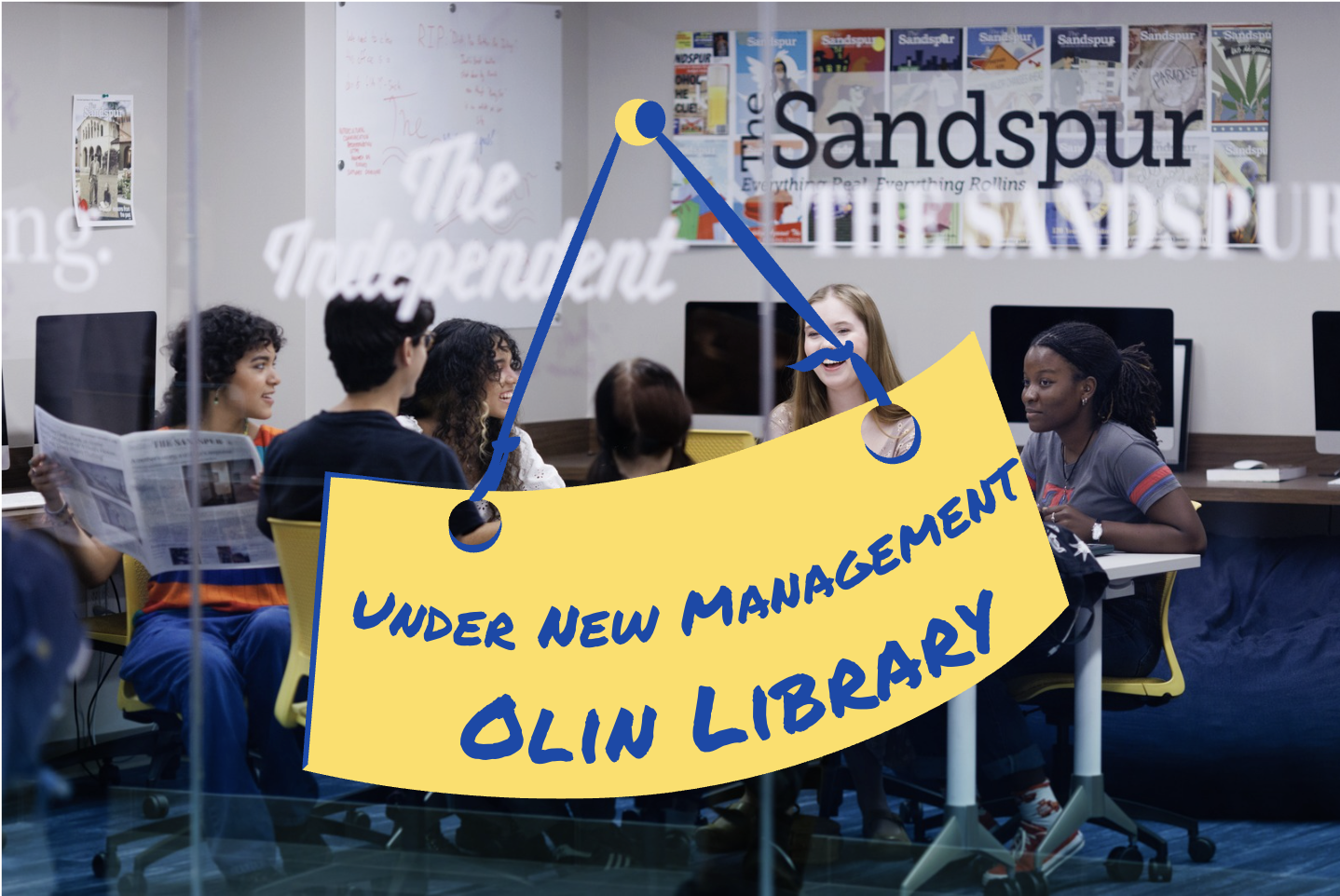
Stark’s position, one of the six members of the President’s cabinet, was eliminated on Aug. 1 to offset the costs of creating a new cabinet-level position committed to addressing the strategic needs of the College. In a statement from Barnett — shared publicly on Stark’s LinkedIn page — these new areas of focus will be “legal affairs, risk management, and government relations.” At this time, no personnel has been announced to fill this new position, though Barnett assured that she would share more updates when her plans were finalized.
Stark’s departure from the college left departments that directly reported to him — Student Media included — in need of a new organizational home. Director of Student Media Greg Golden said that he originally got the idea to house the department under the Olin umbrella from Prof. Emily Russell (PhD), Chair of the English Department. Russell advised Golden to consider Olin “based on the work that she has seen them do, the direction of the library, [and] the way in which they connect students with not just services, but opportunities to apply their learning.”
Russell’s insights quickly bore fruit, and Golden soon began meeting with Derek Malone, Dean of Olin Library, who had simultaneously been having similar conversations about how the restructuring would work with the Provost’s Office.
For Malone, the pairing seemed like “a very natural fit… there are so many crossover things [that] we were doing already. There are so many … challenges and opportunities that Library services, Tutoring and Writing services, and Student Media face together.”
Malone also clarified that Student Media is joining Olin as a Library Department since the organization encompasses more than the physical library itself. Other departments housed within the library’s structure include the Tutoring and Writing Center, the Archives and Special Collections, and Digital Strategies & Scholarly Communication.
Many of these departments either already have partnerships in place with Student Media or have the potential to benefit from working together, Malone added. Student Media’s edited creative publications, Brushing and The Independent, both already maintain their digital presence through Olin’s publishing services. The Sandspur, similarly, has its archives maintained through Olin as well. Looking forward, though, Malone sees Olin’s unique web challenges as being even more synergistic with the goals of Student Media.
Where most Rollins departments maintain an outward-facing webpage for the public and keep all internal college content within MyRollins, Olin must maintain a webpage that caters to both internal and external audiences as a part of their obligations for Interlibrary Loan reciprocity and membership in the Oberlin Group of Libraries — a collection of 88 member libraries from small universities and liberal arts colleges throughout the U.S.
“We can’t have all of our content behind MyRollins because people [outside of Rollins] have to see it. We also don’t want to just be an advertisement unit [to the] outside because they have to actually be users [inside Rollins] too,” Malone said, noting how WPRK and The Sandspur also have this challenge to serve the Rollins community while simultaneously catering to an external audience.
Malone and Golden both spoke highly about their new partnership, reflecting on the ongoing conversations they have with one another and the library tour they have been engaged in as they try to discover all the ways that Student Media will be able to collaborate more fully with its sibling departments. While many opportunities have been obvious — like sharing subscriptions for web hosting platforms — others have arisen quite unexpectedly, like managing a large student employee base.
“When [Greg] was meeting with [the Tutoring and Writing Center],” Malone said, “I thought we were going to meet around ‘What can [TWC] help do for The Sandspur? What can [TWC] help for The Independent? Is there one of our workshops that would be good for Brushing authors?’ When we got in the room,” he continued, “they started talking about student [employee] supervision. We [were] taking a completely different path [from what I thought], but it’s still super helpful for them because they have common concerns.”
These dialogues also prelude the importance of strong ties between libraries and independent media as higher education deals with ongoing political challenges. “The similarities are striking,” Malone said.
Amidst heated budget debates in the federal government that have resulted in an ongoing shutdown — on track to become the longest shutdown in American history — libraries have been targeted; one of the demands of President Trump’s proposed budget includes the elimination of the Institute of Museum and Library Services (IMLS), the independent agency within the federal government that serves as the main source of federal support for libraries and institutions.
Just two weeks into the shutdown, the U.S. witnessed one of the largest media exoduses in American history. Journalists from nearly every major news network walked out of the Pentagon after refusing to sign onto new reporting standards that, among other demands, stated that journalists could only report information that was directly approved by Defense Secretary Pete Hegseth.
While Rollins as a private liberal arts college has been shielded from the brunt of the threats to higher education made by the Trump administration and the Florida Department of Education, President Barnett’s choice to reprioritize external communications to focus on government relations and legal protection may suggest a strategic plan that is bulwarking against future threats. Considering this, Malone reemphasized the benefit of having strong lines of communication and support already established between Olin and Student Media: “[At our Department Head meetings] we can share ideas, and we can share challenges or interferences that we see and then help [one] another. I definitely think that is [something] that can be highly leveraged and helpful in the future.”
As they continue to look for new opportunities for collaboration, both Golden and Malone are optimistic about the future. Golden did clarify that despite this being a significant structural shift, the merge won’t cause any offices to be moving around. “[Kathleen W. Rollins Hall] will remain Student Media’s home,” Golden said. Golden did add that Olin would be a helpful ally in securing event spaces for Student Media projects.
Despite this, the departments remain eager to find more opportunities for collaboration wherever they arise. “I think this is going to be a great partnership. It’s been a great three months with Greg so far… I’m very excited about the future and I think we’ve got some great possibilities ahead of us,” Malone said.
Golden’s views echo Malone. “It just feels really good to have a strong home base of folks who have our back,” he said, “and a home base that we know won’t be changing anytime soon, ideally.”






Comments are closed.