
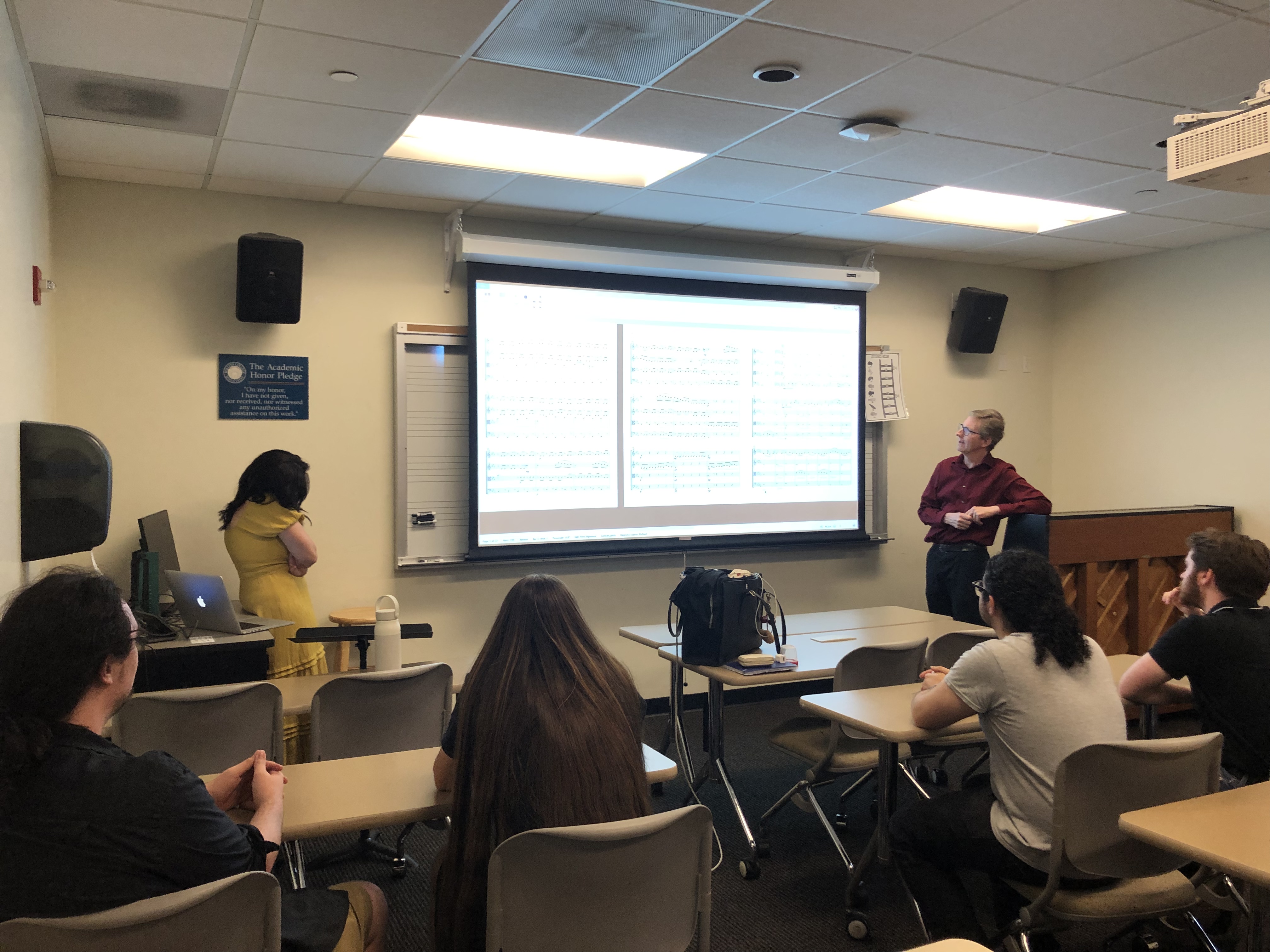
No two music students take the same list of classes before they graduate, as there is remarkable variation within the one major. Some focus on music education, others on vocal performance, and still others on music technology. One of the lesser-known classes offered to music students, however, is Composition Practicum. Any student who has taken Music Theory II can sign up for the opportunity to learn how to compose.
The class is offered three times a week for one hour but only requires students to come to one session per week. On a typical day, an aspect of composition is discussed, such as how to write music for the harp or a string quartet. The class listens to a piece demonstrating the instrument or technique, and students are given a “micro-assignment” to write a short piece within a set of guidelines. The next week, students can present their work through music notation tools, such as Sibelius and MuseScore, or by playing their compositions on the piano. At the end of the semester, a composition concert is organized for which students can recruit players (or themselves) to perform complete compositions in the John M. Tiedtke Concert Hall in Keene. Some students have taken the class every semester for years and choose to debut their best works in a composition recital–a 30-minute or hour-long concert of entirely their own pieces. In past iterations of the class, students have written arrangements for Christmas Vespers, Bach Festival events directed by Dr. John Sinclair, and other Rollins ensembles.
The college’s music theory professor and composer, Daniel Crozier Ph.D., is perhaps best known by many students as the nephew of alum Fred Rogers (‘51), who graduated with a Major in Music and performed a composition recital at the college. However, Crozier has established a career of his own as a composer, and his works have been performed by a range of artists from saxophone player Branford Marsalis to the Seattle Symphony Orchestra. He passes on a deep appreciation for 20th century American classical composers to his students through his selection of exemplary works by Aaron Copland, Charles Ives, and Samuel Barber (along with pieces by a range of classical composers), but encourages students of his class to write and present works across genre lines.
Regarding the reason for teaching the class, which has been offered at the college for decades, Crozier notes, “It’s important for students to hear their compositions performed by musicians. The rehearsal process and the concert itself are the steps that teach students the most about composition because they are able learn from factors such as the balance of various instruments on a real stage,” in an era when music notation applications can generate informative but imperfect audio previews of a student’s composition.
As a result of these technological advances, fewer live performers come to the class to premiere works, according to Crozier. “More scores used to be written by hand, and more people played their scores on the piano. That is a good skill for composition students to maintain.” There are advantages as well to the changes, though. Computer applications and the ability to project one’s sheet music to the entire classroom allow students to analyze works in progress in real time and make suggestions for composers to implement at the click of a button.
Over the years, guest composers have visited the class to offer guidance to students, including Morten Lauridsen, Richard Einhorn, George Tsontakis, and Pulitzer Prize winner John Harbison. Composition professors from regional colleges visit, as do musicians who can speak about the technical aspects of writing for their instrument.
In the most recent class I attended, the works presented included a string quartet (which students are shown analyzing in the photo above) and a setting of the Kyrie eleison for voice. The week’s micro-assignment for students was to compose melodies for violin and bassoon in neither the major nor minor scales. Students needed to consider the limitations of the instruments, such as their range and–for the bassoon–gaps for breathing, in their assignments.
As usual, at the end of the fall semester there will be a composition concert by the class’s students. It is scheduled for Sunday, Nov. 23 at 7:30 pm in Tiedtke Concert Hall in Keene. All Rollins students are welcome to attend for free.
The opinions on this page do not necessarily reflect those of The Sandspur or Rollins College. Have any additional tips or opinions? Send us your response. We want to hear your voice.



Comments are closed.