
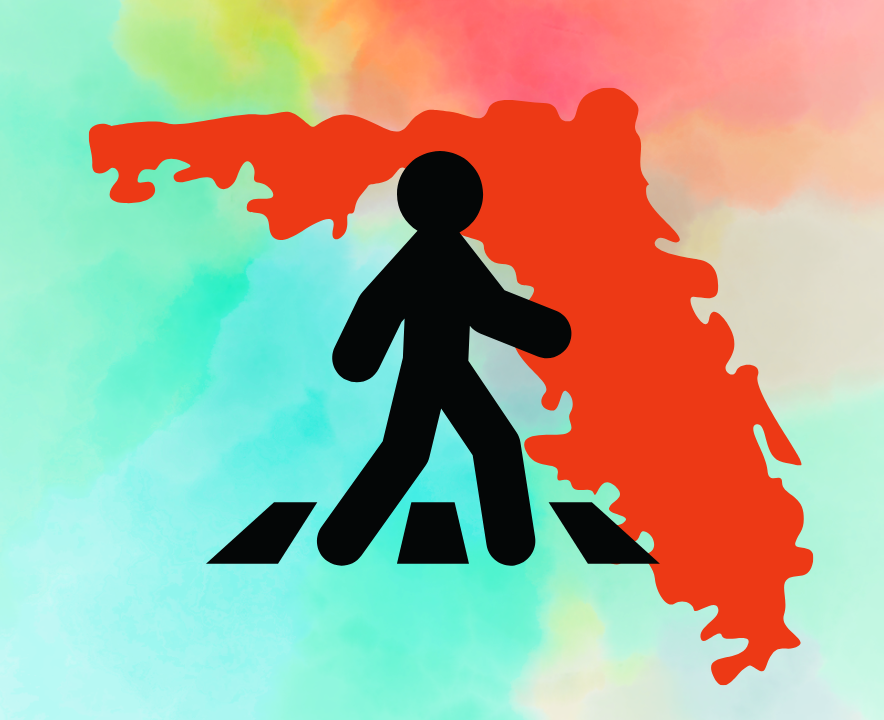
A little color never hurt nobody.
Or so you’d think.
In the dead of night on Wednesday, Aug. 20, workers from the Florida Department of Transportation (FDOT) painted over a crosswalk on the corner of Orange Avenue and Esther Street.
On the corner of those two roads sits the Pulse nightclub; the site of the June 12, 2016 mass shooting that killed forty-nine people — at the time it was the deadliest mass shooting. The since-abandoned nightclub is a state funded memorial, including a rainbow crosswalk crossing Esther Street. The same crosswalk painted over by the FDOT.
The uproar was immediate; Orlando Mayor Buddy Dyer posted a statement on social media calling the removal of the crosswalk “a cruel political act.” By the following afternoon, the crosswalk had returned to its rainbow state due to the actions of Orlando locals who flocked to the intersection to assist in repainting by chalking over the black and white lines.
Yet, two days later FDOT had once again painted over the crosswalk, putting Florida politics in the crosshairs of public opinion, as arrests began to be made against the protesters recoloring the crosswalk.
This isn’t the first time that the Floridian government has found itself in a controversy of their own doing. In May 2023, Florida Gov. Ron DeSantis, signed a series of bills with the intention of scaling back freedoms for the LGBTQ+ community. The most controversial of the bills was known as the “Don’t Say Gay” bill, which banned educators for mentioning sexual orientation and gender identity in the classroom.
The bill was met with pushback from the Florida community and LGBTQ+ advocates, as the Human Rights Campaign explained that Don’t Say Gay “creates an anti-LGBTQ+ definition of sex based on reproductive function, and would force school staff and students to deadname and misgender one another.”
After the initial painting over of the Pulse crosswalk, the FDOT sent letters to other Florida cities, including Key West, stating that if the crosswalks at Duval and Petronia Streets in the historic gay community known as the Pink Triangle were not removed by Sept. 3, “the Florida Department of Transportation will remove them by any appropriate method necessary without further notice.”
Government officials in Key West pushed back against the FDOT, delaying the removal of their crosswalks until the early morning hours of Tuesday, Sept. 9. In a statement, City Commissioner Sam Kaufman announced the “FDOT has determined that our city’s crosswalks do not comply with state traffic control device standards and has ordered that they be remedied. This decision follows a process that, in my view, lacked fairness and impartiality…Our community is left without a chance to challenge whether FDOT applied its own standards in an unbiased and just manner.”
Kaufman concluded his statement by reiterating that “Key West remains steadfast in our commitment to celebrating equality, diversity, and love where everyone belongs.”
In addition to Orlando and Key West, other cities like Miami Beach, Fort Lauderdale, St. Petersburg, and Delray Beach also received notices to remove their street art. St. Petersburg was the only of the cities to comply with the state after receiving notice of the art’s removal.
The removal of street art is supposed to comply with a memo from US Secretary of Transportation Sean Duffy, who over the summer mandated that all roads must be free of political messages or non-standard art. This applied not only to the Pride art in Orlando and Key West, but also to the checkered flag crosswalks in Daytona Beach that were painted over — once again in the dead of night — by the FDOT.
Duffy and the FDOT both argued that it is their duty “to ensure the safety and consistency of public roadways and transportation systems” and that it meant “ensuring our roadways are not utilized for social, political, or ideological interests.”
However, many Floridians pushed back against the so-called safety of the roadways. The Orlando Sentinel found that at four intersections on Orange Avenue where murals had been painted — including the one at Esther — vehicle incidents dropped sixty-five percent. An April 2022 study by Bloomberg Philanthropies, which studied the correlation of street art and accidents, found that when street art was installed there was a fifty percent decrease in crashes involving pedestrians and a thirty-seven percent decrease in crashes leading to injuries.
While the FDOT is of the opinion that the removal of street art will make the streets safer, the data shows that is not the case. The removal of the Pulse memorial crosswalk, along with others in Key West and St. Petersburg are simply just another check box on the state’s agenda. With election season right around the corner, perhaps ask yourself what you’d like to see when you walk through downtown Orlando in four years.
The opinions on this page do not necessarily reflect those of The Sandspur or Rollins College. Have any additional tips or opinions? Send us your response. We want to hear your voice.




Comments are closed.